Property Assistance & Enquiries

Find Your Dream Property
Search verified listings and top builders instantly across India.
When Should You Choose an Off-Grid Solar System for Your Home?
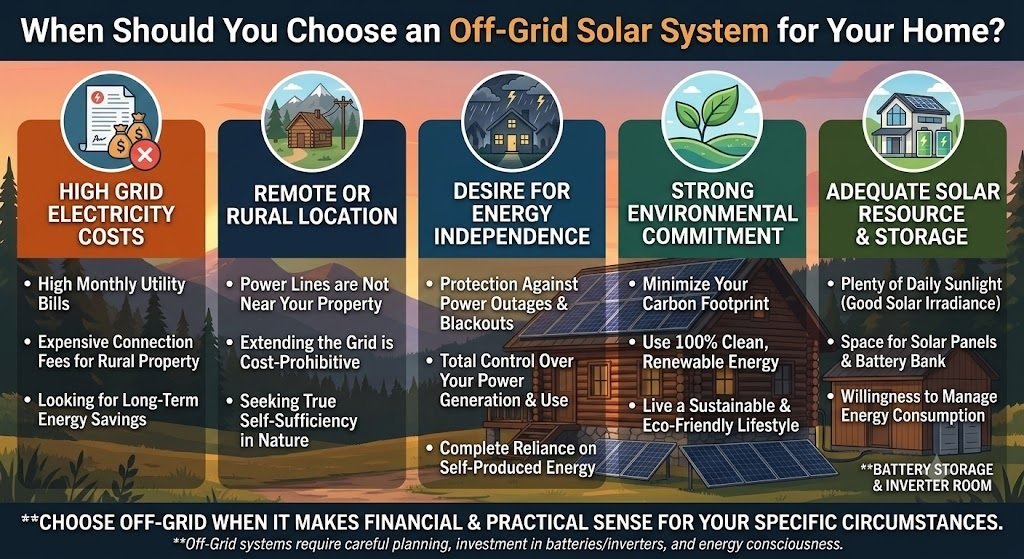
When Should You Choose an Off-Grid Solar System for Your Home?
Category: guide
Homebuyers and developers see it as a necessary infrastructural decision. Although the global trend is towards renewable energy, India needs an in-depth analysis of geography, load requirements, and long-term budgetary considerations before installing Off-Grid Solar Systems for Houses.
Currently, the Indian B2B market and residential construction sectors are experiencing their share of changes. As grid quality deteriorates in various urban peripheral localities and battery technology cost (especially Lithium Ferro Phosphate, LFP) keeps dropping, the debate about "off-grid" has made its way from the margins and become a normal part of procurement discussions. On the other hand, the intricacy of such a system demands them to be more than just a marketing voice.
1. Defining the Off-Grid Framework
To be able to make an intelligent buying decision, one should first understand the differences between the three major solar architectures that are sold in the market. An off-grid system is a complete independent system. Unlike on-grid systems that treat the electric utility grid as a virtual battery through net-metering, an off-grid setup is physically separated from the DISCOM (Distribution Company) lines.
Standalone System Key Parts
● A single panel that makes power when sunlight hits it. This part turns light into electricity you can use later.
● A solar battery bank holds power collected by panels. Most often it uses tubular lead-acid cells. Sometimes lithium-ion takes its place instead. Each type keeps electricity ready for later use.
● Power moves both ways through this device when there is no connection to the main electricity network. It manages voltage without relying on external signals.
● Power flows from solar panels through devices called MPPT charge controllers. These adjust voltage so batteries store energy safely. Voltage levels shift depending on sunlight and battery needs. The system runs without manual input. Efficiency improves when matching panel output to storage demands. Smooth operation depends on consistent internal regulation. Components respond dynamically throughout the day.
Picture a home running on its own power. The inverter acts like the thinking part of an off-grid solar setup. When lights go dark across town, regular grid-tied inverters shut down - safety demands it. Yet standalone versions keep going by creating their very own electric rhythm. No outside signal needed. They build voltage from nothing. Power flows because they decide how fast and strong it runs.
2. When to Choose Off-Grid: The Three Critical Use Cases
The reason to go off-grid should be, at most, a combination of necessity and strategic independence. Most of the time, the only reason to disconnect from the grid is to reduce your monthly electricity bill. There is no doubt that in most Tier-1 Indian metro areas, an on-grid system will give you a faster return. On the other hand, there are three main reasons why off-grid may be the best alternative.
Case A: Remote Locations and Infrastructure Gaps
Even though power supply to rural India is rapidly improving, there are still several "farmhouse" developments outside of big cities like Pune, Bangalore or NCR where electricity connection remains the last-mile struggle. If the cost of the extension of the High-Tension (HT) line and installation of the private transformer is higher than the Capex for the solar system, off-grid solution should be considered.
I mean, think about it, when you consider the new connection RoW (Right of Way) issues and the rural connection procedures in addition to the autonomy provided by a standalone system, the higher upfront cost is nicely compensated.
Case B: Chronic Grid Instability (The "Virtual" Off-Grid)
When load shedding is more than 6-8 hours per day in a certain area, a normal on-grid system will not work for the other half of the day. Since on-grid systems depend on a stable grid signal to function, they cannot supply power during blackout. A home office or a residence with 24/7 climate control is best served by an off-grid system that offers guaranteed power at all times.
Case C: Zero-Export Constraints
In some states of India, DISCOMs seem to be less and less willing to approve net-metering in order to protect their revenues. It might be that a local utility rejects your net-metering application or provides unfavorable "gross-metering" terms which then make it hardly worth being connected to the grid from a financial point of view. Under these circumstances, using and storing 100% of your production is more beneficial than allowing the utility to take your surplus energy without proper credits.
3. The Technical Audit Practical Size Over Theory
Here’s the thing about solar - lots of companies stick to old scripts, selling what sounds good instead of what fits. When homes connect to the power grid and panels fall short, electricity flows in from outside without fuss.
Step 1. Accurate Load Assessment First
This one defies prediction. Without a detailed Load Chart, you're lost.
● A lone spark of light pulses, keeping walls breathing. Through long stretches, fans drone on - air shifting, constant. Not sleeping, routers guard links like sentinels. Every dark corner gets scanned by security eyes that won’t close.
● Sometimes you’ll find a fridge doing its quiet job. A pump moves water when needed. The washing machine runs only now and then.
● Frequently drawing high power? Think air conditioner running through summer days. A water heater keeping temps steady counts too. Charging an EV overnight also fits the pattern. Each of these uses energy nonstop when active. Heat, cooling, transport - common needs behind heavy draw.
A quick note on off-grid solar setups for homes: inverters must manage sudden bursts of demand. Though some appliances run at 1,500 watts, they might pull double that briefly when kicking on - like how an AC unit revs up its compressor. Because of this jump, pick a system ready for spikes. After all, smooth operation depends on covering those split-second highs.
Step 2: The "Autonomy" Factor
In the context of Indian monsoon, Autonomy means the number of days your battery will run your home without any sunlight.
● Normal suggestion: 1.5 to 2 days of autonomy.
● High-rainfall zones like Kerala or NE states: 3 days of autonomy is considered an industry standard.
4. Sourcing Reliable Hardware from Indian Manufacturers
Facing power needs alone changes how you see value. Few vendors try to push cheap quality gears in India.
Lead-Acid vs. Lithium
Now things are getting quieter by the moment. Though tubular lead-acid batteries come cheaper at first glance, here's the catch - they can safely use only around half their full capacity. Picture a 100Ah unit: what really runs your gadgets lands close to 50Ah. Over months, that hidden gap begins tilting the balance in ways few expect.
Yet lithium LFP batteries let you tap into 90 percent of their power while running strong over the past ten years. Decades of home solar setups living off grid show one clear pattern - lithium wins on total cost every time.
Panel Efficiency
For roof applications where space is limited, Mono-PERC Half-cut panels are considered the present best solution. They have an excellent performance, especially in the diffused light condition during smoggy winters and monsoon months in India.
Component Minimum Standard Pro-Level Choice
Panels Polycrystalline Mono-PERC Bifacial
Inverter Modified Sine Wave Pure Sine Wave (Transformer-based)
Battery Lead-Acid (Tubular) Lithium Ferro Phosphate (LFP)
Controller PWM MPPT (High Voltage)
5. Maintenance and the "Indian Factor"
The off-grid system is, basically, a mechanical organism. In the world of B2B, we often refer to it as "O&M" (Operations and Maintenance). For homeowners, it's simply "taking care of things."
● Soiling Losses: Dust is, by far, the biggest enemy of the return on investment in India. In a matter of weeks, a fine layer of dust can bring down the efficiency by 20%. Concentrate on easy cleaning method while selecting the mounting structure/.
● Heat Dissipation: Summer in India can really stress inverters and batteries. Your battery will deteriorate faster if you keep it in a stuffy small room without ventilation and the temperature is 45°C or higher.
● Earthing Protocol: Please, do not forget about lightning arrestors and chemical earthing. It just seems like one more expense, but only one lightning strike during the monsoon season can damage the entire PCU (Power Conditioning Unit).
6. Financial Analysis: Beyond the Sticker Price
Apart from the absence of government subsidies, Off-Grid Solar Systems for Houses are mainly held back by the fact that Indian state and central subsidies (such as PM Surya Ghar Scheme) are primarily targeted at grid-connected installations.
On the other hand, one should consider the "Avoided Cost" as well.
● Diesel Savings: If you intend to use a DG (Diesel Generator) set as a backup, determine the unit cost of the diesel-generated power (approx. ₹25-35/unit). After the initial CAPEX, solar power will be available free of charge.
● Output: If you work at home or even run a small business from there then the real measure is how much "downtime" costs you.
To me, it looks like the majority of buyers simply focus on the "payback period" (usually 7-9 years) while forgetting about the "security value." You basically just "pre-paid" your electricity for the next 25 years at a fixed rate.
7. Common Mistakes to Skip
Just because it says hybrid doesn’t mean it acts like one. Some run only on batteries unless hooked up to outside power by a wire. Real ones sync completely with the main supply, pushing surplus energy outward. Look close at how each one operates before deciding. The model available may fall short of assumed functions.
● Wires too thin? Power dips before it arrives. Your installer should pick solar-grade DC cables - ones that fight UV damage - instead of regular home wiring. Skip the shortcuts.
● Midnight rolls around, batteries drained - because someone mixed up daylight with usable sun. India gets four to five solid solar hours daily, not ten. Counting on full-day light means oversizing everything. That mistake? It leaves systems hungry when night falls.
Conclusion
Installing Off-Grid Solar Systems for Houses is not only about becoming an energy literate person, it is also about making the right decision if you are living the experience of being in a far-flung area, suffering from an unstable electricity supply or if you simply value autonomy at a greater level than ROI. With an off-grid system, although there is a greater initial cost and a strict control over the level of consumption, the reliability offered is beyond what today’s centralized grid can provide especially in most parts of India.
Before signing a contract, make sure you get a "Shadow Analysis" of your roof plus a "Cycle Life" guarantee for your batteries. In the Indian solar market, the best deal is not the cheapest one, it is the one that will keep your house lit when the entire neighborhood is in the dark.
May I design a personalized load-calculation list for you through which you can assess the know-how of your solar provider according to your specific home-layout?
